
What NFPA 99 actually requires from plastic sheeting in healthcare facilities — and the compliance detail most spec sheets leave out.
Healthcare facilities run on systems that cannot fail quietly. Oxygen lines, electrical distribution, flammable anesthetic agents in some older ORs, and sensitive imaging equipment all operate close to patients, staff, and visitors. None of them chose to be part of a construction zone. That is the environment NFPA 99 was written for. It is also the environment your temporary containment, covers, and partitions have to survive inspection in.
If you’re specifying or installing plastic sheeting for a hospital or surgical center, “meets code” is not optional language. That applies to covers, temporary walls, dust barriers, and equipment protection alike. It is a specific, testable requirement, and most general-purpose poly sheeting does not meet it.
What Is NFPA 99?
NFPA 99, the Health Care Facilities Code, is published by the National Fire Protection Association. It exists to minimize fire, explosion, and electrical hazards in spaces where patients, staff, and visitors are present. The code assigns risk categories — 1 through 4 — based on the consequence of a system or space failing. It does not assign one blanket rating to the whole building.
Category 1 covers systems, equipment, or spaces where failure is likely to cause major injury or death. Category 2 drops that risk to likely minor injury, and Category 3 to possible patient discomfort with no likely injury. The lowest tier, Category 4, has no impact on patient care at all. A single hospital typically contains all four categories at once. An operating room and a break room are not held to the same standard, even though they’re under the same roof.
Most general-use plastic sheeting builds up a static charge through ordinary friction — being unrolled, walked past, taped, or moved by HVAC airflow. In a facility with flammable gases, sensitive electronics, or oxygen-rich environments, that static charge is a liability.
An electrostatic discharge (ESD) happens when that stored charge jumps between two objects at different potentials. In the wrong environment, that spark is the exact ignition source NFPA 99 exists to prevent. Sheeting that cannot bleed off a static charge at an acceptable rate does not belong in these spaces. That’s true no matter how good its fire rating looks on paper.
How Antistatic, Fire-Retardant Sheeting Meets the Standard
Antistatic plastic sheeting is engineered to dissipate static charge instead of holding it. Its surface resistance lets a charge drain off in a controlled way, rather than building up and releasing all at once. Static decay testing works by charging the sample to a high voltage while it’s ungrounded. The sample is then grounded, and a timer measures how quickly the residual charge falls to a low, defined threshold. [FLAGGED: exact decay-time threshold not independently verified — confirm against Americover’s test certificate before publishing a specific figure.]
Fire performance is a separate test, and a compliant product has to clear both. That’s the combination healthcare specs are really asking for: a material that resists ignition and flame spread, and one that won’t generate the static spark that starts a fire in the first place.
Standards and Specifications to Look For
When you’re comparing plastic sheeting for a healthcare project, look for these standards on the product’s documentation — not just the marketing page:
- NFPA 99 — Health Care Facilities Code. Governs static-decay performance for materials used in and around patient care spaces. (NFPA)
- NFPA 701 — Tests flame propagation of films and textiles. A passing material self-extinguishes and limits char length rather than continuing to burn. (NFPA)
- ASTM E84 — Measures surface burning characteristics: flame spread and smoke development. Class A (Class I) is the most stringent rating in this test. (ASTM)
- ANSI/ESD STM11.11 — Measures surface resistance of static-dissipative planar materials, used to characterize how well a material controls static buildup. (ANSI)
- UL 214 — Covers flame-resistance performance for fabrics and films used in applications like tents, awnings, and draperies. It’s commonly cited alongside NFPA 701 for containment sheeting.
Americover provides the fire and static-control test documentation with every order, not after the AHJ flags it during a walkthrough. A sheet printed with a visible fire-retardant marking is what an inspector wants to see in the field. It should be backed by a certificate that references the specific product installed.
Practical Applications in Healthcare Facilities
Antistatic, fire-retardant sheeting shows up in more places in a hospital than the OR. Common uses include:
- Temporary containment walls and dust barriers for renovation in occupied wings (ICRA-driven infection control containment)
- Equipment and imaging suite protection during construction or servicing
- Covers for sensitive electronics, server rooms, and telecom closets housed within healthcare campuses
- Vapor barriers in wall assemblies where the same product needs to double as fire-retardant sheeting
| Product | Image | Key Spec | Link |
|---|---|---|---|
| Tuff-Scrim™ Antistatic Fire Retardant Reinforced Poly Sheeting | 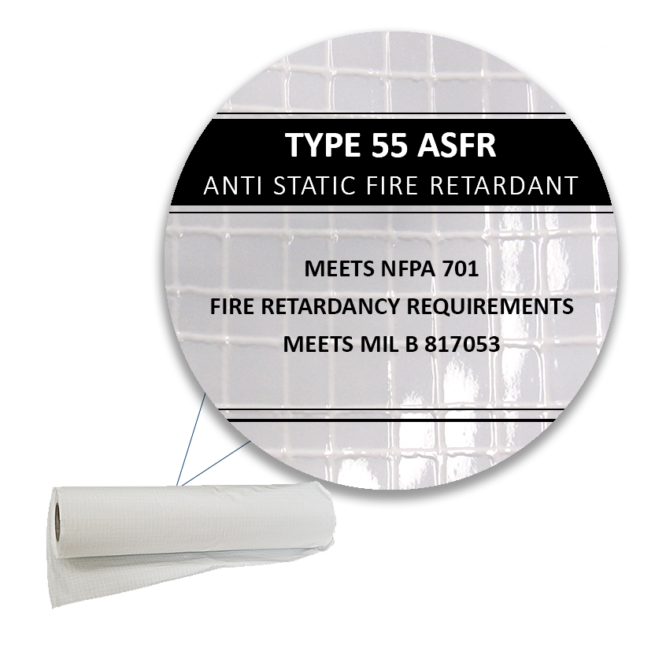 |
6 mil reinforced 3-ply laminate; NFPA 701 Large Scale, NFPA 99 static decay, Class I/Class A flame spread (ASTM E-84) | View product → |
Tuff-Scrim’s reinforced grid construction bonds two layers of linear low-density polyethylene film around a high-strength cord grid. That adds tear and puncture resistance for demolition-adjacent or high-traffic containment. It does this without adding bulk beyond the 6 mil thickness the application needs.
Americover is the smart source for plastic and polyethylene sheeting. Our knowledgeable staff can help you match the right product to your facility’s specific containment or partition requirement. Call 760-388-6294 or contact us Monday through Friday, 7:30 a.m. to 4:30 p.m. Pacific.
Frequently Asked Questions
Does NFPA 99 apply to plastic sheeting used for temporary covers and containment?
Yes. NFPA 99 sets fire, explosion, and electrical risk criteria for materials used in and around patient care areas. Static-generating materials are a recognized hazard in spaces with flammable gases or sensitive electronics. Sheeting used for covers, temporary walls, or containment in these areas needs to meet the applicable static-control and fire-performance requirements.
Which edition of NFPA 99 does my healthcare facility need to meet?
It depends on your certifying and enforcing authorities. CMS currently enforces the 2012 edition of NFPA 99 for Medicare and Medicaid certification, even though NFPA has since published newer editions. State health departments and local AHJs may reference a different edition. Confirm with your facility’s compliance team rather than assuming the newest NFPA edition applies.
Can regular 6 mil poly sheeting be used in a hospital?
Standard poly sheeting without antistatic and fire-retardant treatment generally will not meet NFPA 99 or NFPA 701 requirements. It can build up static charge through normal handling. It also doesn’t carry a fire-retardant rating, making it a poor fit for occupied healthcare construction.
What’s the difference between antistatic and ESD-certified plastic sheeting?
Antistatic materials dissipate static charge at a controlled rate, which is what NFPA 99 is concerned with. Fully ESD-safe environments are a stricter classification, governed by standards like ANSI/ESD S20.20. They typically apply to electronics manufacturing rather than general containment. For a closer look at that distinction, see Is Anti-Static Fire Retardant Plastic Sheeting ESD Safe?
Where in a hospital is antistatic fire-retardant sheeting typically required?
Common applications include ICRA containment barriers during renovation in occupied wings and covers for imaging and diagnostic equipment. It’s also used to protect in-facility server and telecom rooms, and for temporary partitions near oxygen or anesthetic gas lines.
What documentation should I request before ordering?
Ask for fire certificates referencing the specific product and edition of the standard tested, plus any static-decay or ANSI/ESD test data. Americover provides fire certificates and test documentation with every order. We also provide it on request for submittal review prior to purchase.
Spec It Right the First Time.
Americover supplies antistatic, fire-retardant plastic sheeting built for healthcare environments — tested, documented, and manufactured in the USA. Browse antistatic fire-retardant sheeting →