
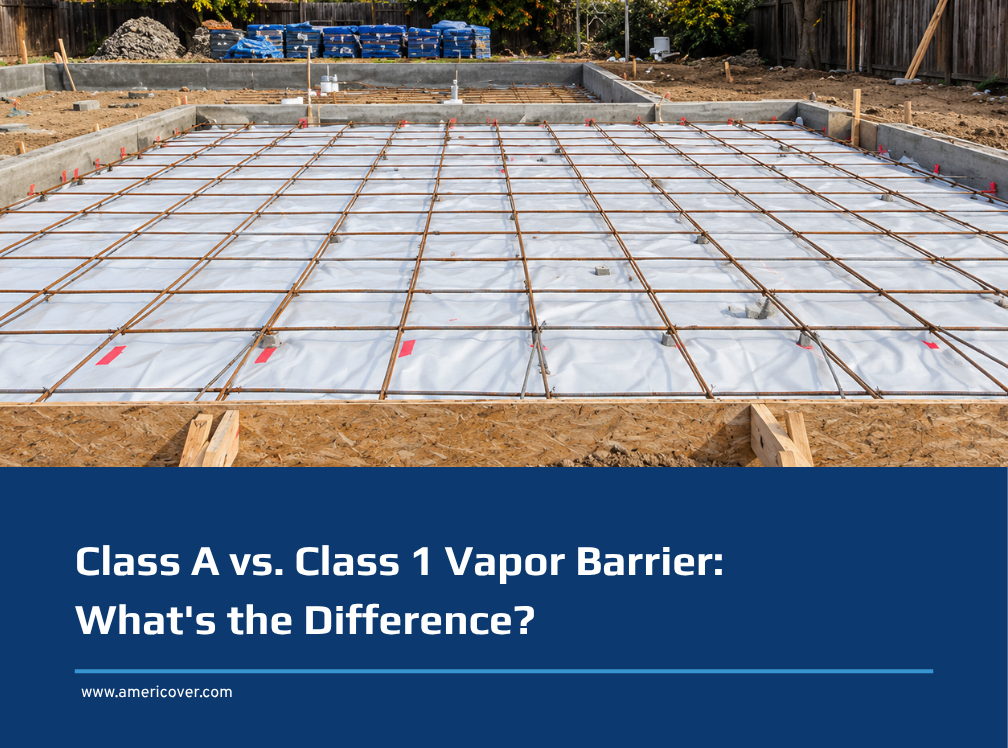
Class A vs Class 1 vapor barrier: one is a building code perm rating, the other is a jobsite durability standard. Here’s how to tell them apart before the submittal goes out.
A spec calls for a “Class A vapor barrier.” The supplier’s data sheet says “Class 1.” When it comes to Class A vs Class 1 vapor barrier ratings, are they the same thing?
No. In fact, they answer two different questions.
First, Class 1 asks: how much water vapor gets through this material? Then Class A asks: will this material still do its job after a crew drags rebar across it and pours a slab on top?
As a result, mixing them up is one of the most common submittal problems on slab-on-grade work. So here’s the breakdown.
Quick Comparison
| Class I (“Class 1”) | ASTM E1745 Class A | |
|---|---|---|
| Defined by | Building codes (IRC, IECC) | ASTM E1745 material specification |
| Applies to | Any building material — walls, roofs, crawl spaces, slabs | Plastic vapor retarders in contact with soil or granular fill under concrete slabs |
| Perm requirement | 0.1 perm or less | 0.1 perms maximum |
| Tensile strength | Not required | 45 lbf/in minimum |
| Puncture resistance | Not required | 2,200 grams minimum |
| Perm tested after conditioning? | No — one test on the material as received | Yes — after soaking, heat, cold, and soil organism exposure |
Class I Vapor Retarder: A Perm Rating, Nothing More
“Class 1” is almost always shorthand for a Class I vapor retarder. The codes write it with a Roman numeral. Meanwhile, the industry writes it every other way.
The International Residential Code sorts materials into three vapor retarder classes by permeance:
- Class I: 0.1 perm or less
- Class II: more than 0.1 and up to 1.0 perm
- Class III: more than 1.0 and up to 10 perms
In addition, the rating comes from ASTM E96 Procedure A, the desiccant (dry cup) method. According to the U.S. Department of Energy, common Class I materials include sheet polyethylene, sheet metal, non-perforated aluminum foil, and foil-faced insulation sheathing.
Notice what’s missing, though. Class I says nothing about strength. For example, a thin sheet of poly and a 20-mil reinforced liner can both be Class I. However, one survives a pour and the other might not.
ASTM E1745 Class A: Perm Rating Plus Proof of Toughness
ASTM E1745 covers one job: plastic vapor retarders placed in contact with soil or granular fill under concrete slabs. It sets three classes. All three share the same 0.1-perm maximum. Instead, what separates them is physical strength:
- Class A: 45 lbf/in tensile, 2,200 g puncture resistance
- Class B: 30 lbf/in tensile, 1,700 g puncture resistance
- Class C: 13.6 lbf/in tensile, 475 g puncture resistance
Of the three, Class A is the toughest, so it holds up best under traffic. That’s why it’s the class specifiers reach for when a slab covers moisture-sensitive flooring, occupied space, or a site with sharp aggregate.
The Third “Class A” That Trips Up Submittals
There’s also one more label in the mix. ASTM E84 rates surface burning, and it uses Class A too. Under E84, Class A means a flame spread index of 0–25 and a smoke-developed index of 450 or less. Older codes called that same range Class I or Type I, per the Alaska Housing Finance Corporation’s E84 reference.
So “Class A” on a data sheet can mean a fire rating, not a slab rating. Our own 10 Mil Dura Skrim® Fire Retardant is a good example. It carries ASTM E84 Class A with a flame spread index of 5. However, that’s a fire classification, not an ASTM E1745 classification. Therefore, always check which standard sits next to the letter.
How to Choose
Picking a Class A vs Class 1 vapor barrier comes down to where the sheet goes and which standard the spec names.
Under a concrete slab. The IRC minimum is a 6-mil polyethylene or approved vapor retarder with joints lapped at least 6 inches (IRC R506.2.3). Still, that’s a floor, not a target. If the spec names ASTM E1745 Class A, you need a product tested to E1745, with the report to prove it. Otherwise, a generic 6-mil roll may be Class I and still not qualify.
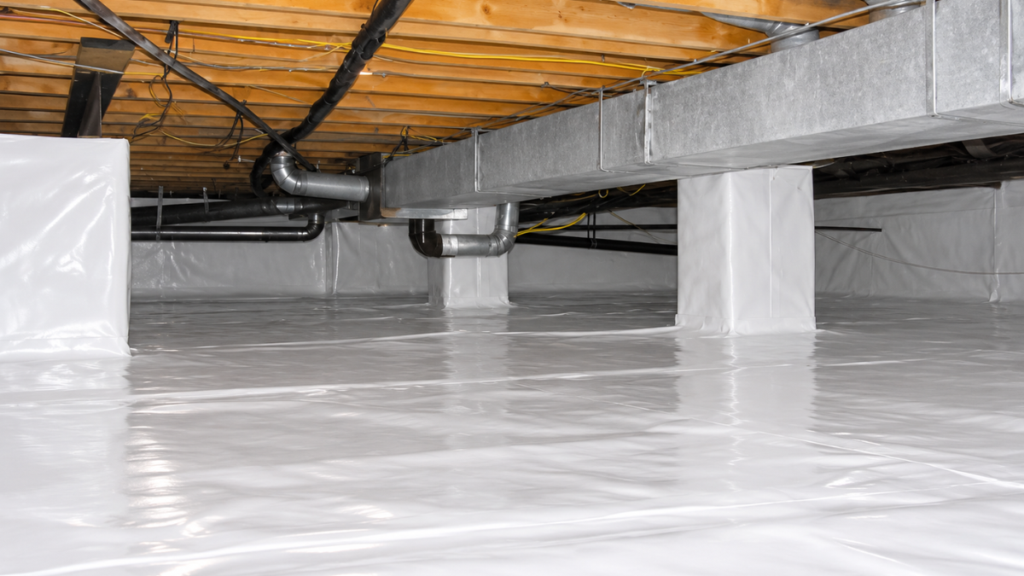
In a crawl space. Generally, most crawl space work is sized to a Class I perm rating plus enough toughness to handle foot traffic and stored equipment. However, if the project also calls for E1745, pick a liner rated to both.
In walls and ceilings. Here, Class I, II, or III is the language that matters, because E1745 doesn’t apply to wall assemblies.
Anywhere fire performance is inspected. In that case, specify ASTM E84 and NFPA 701 by name, in addition to any vapor requirement.
Americover Products by Classification
| Product | Image | Key Specs | Link |
|---|---|---|---|
| VaporBlock® Plus 20 Mil Vapor Barrier |  |
|
View product → |
| Pro Crawl Barrier |  |
|
View product → |
| 10 Mil Dura Skrim® White Reinforced Plastic Sheeting |  |
|
View product → |
| 10 Mil Dura Skrim® Fire Retardant | 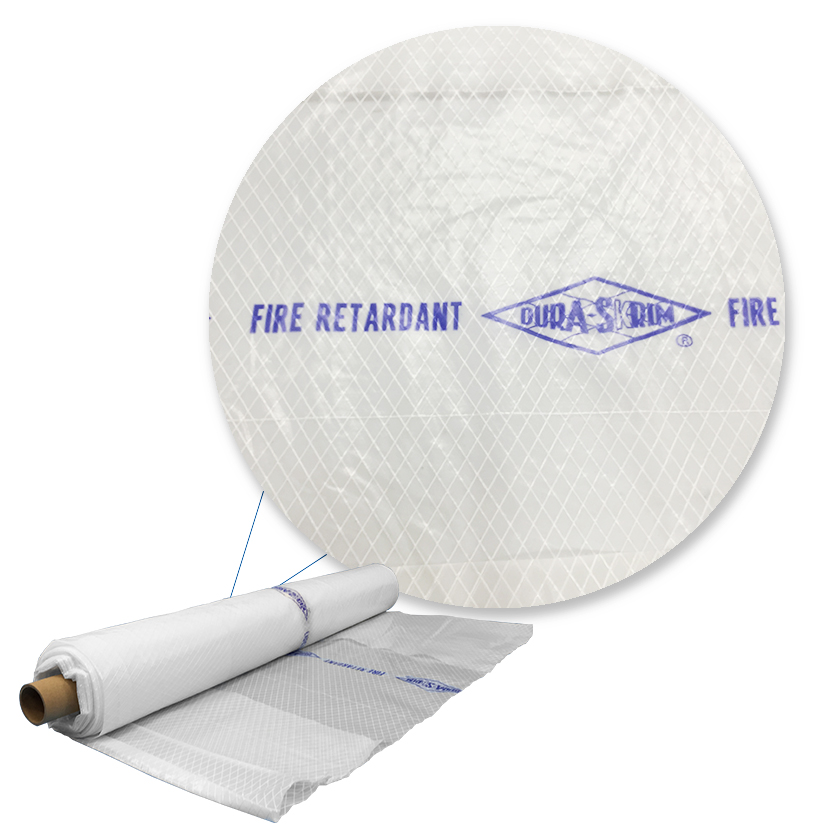 |
|
View product → |
All four are American-made. Finally, for a deeper look at the under-slab standard, read What Is a Class A Vapor Barrier Material?
Frequently Asked Questions
Is a Class A vapor barrier the same as a Class 1 vapor barrier?
No. Class 1 (Class I) is a code rating for permeance of 0.1 perm or less. ASTM E1745 Class A requires the same 0.1-perm limit plus 45 lbf/in tensile strength and 2,200 grams puncture resistance for under-slab use.
Is every Class A vapor barrier also Class I?
In terms of permeance, yes. An ASTM E1745 Class A retarder meets the 0.1-perm limit that defines Class I. The reverse isn’t true — many Class I materials were never tested for E1745 strength or conditioning.
Is 6-mil poly a Class A vapor barrier?
Not unless it’s been tested to ASTM E1745 Class A. Standard 6-mil poly may meet the IRC under-slab minimum, but most 6-mil products are never tested to E1745.
Does Class A on a vapor barrier ever mean fire rating?
It can. ASTM E84 also uses Class A for a flame spread index of 0–25. So check which standard the data sheet cites before assuming.
Does ASTM E1745 apply to crawl space liners?
Strictly speaking, E1745 is written for vapor retarders under concrete slabs. Even so, some crawl space liners are also tested to it, which gives you a documented durability benchmark for high-traffic crawl spaces.
Spec the Right Class the First Time
Still weighing a Class A vs Class 1 vapor barrier? Tell us where the barrier is going and which standard your spec names. We’ll match you with a product and the data sheet to back it up.