
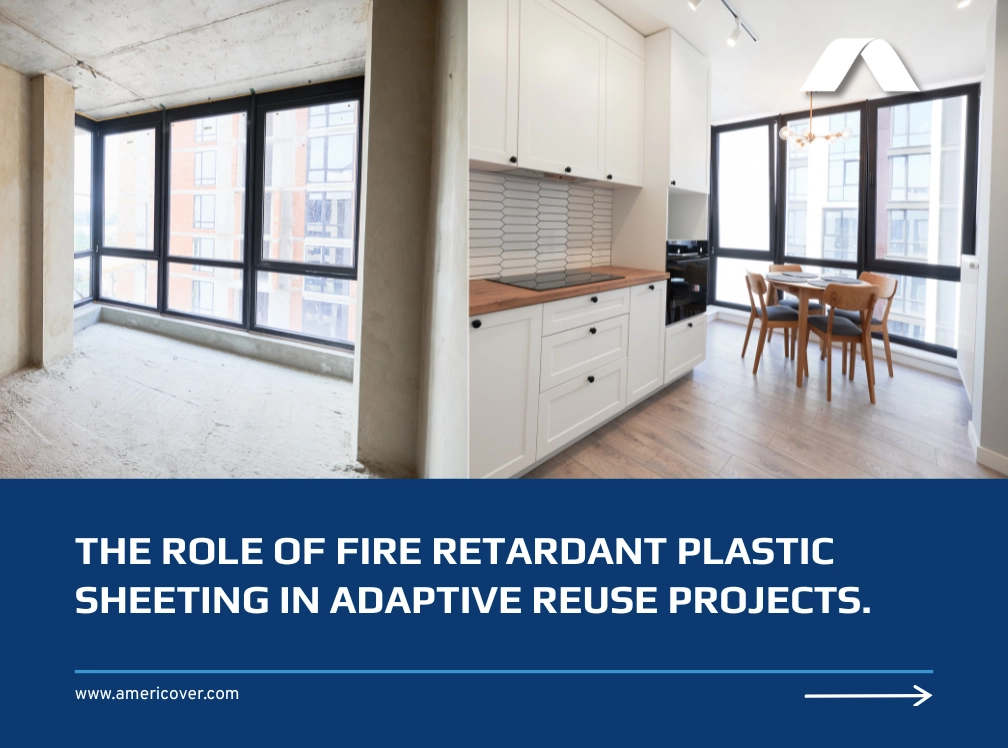
How architects, contractors, and fire marshals use NFPA 701, ASTM E84, and California Title 19 to keep adaptive reuse projects on schedule and on code.
Adaptive reuse projects almost always happen in or next to occupied space. A 1920s warehouse converts to lofts while the ground floor stays leased. An old hospital wing becomes a charter school while the rest of the campus operates. A downtown department store reopens as offices while the sidewalk below still moves people. Because the building is in use, fire codes apply in full — and they apply to the fire retardant plastic sheeting crews install during adaptive reuse construction.
Why Fire-Retardant Sheeting Belongs in the Spec
Temporary plastic is not exempt from fire codes. In fact, occupied renovation environments often face stricter scrutiny than new construction. When crews install sheeting in healthcare facilities, schools, theaters, hotels, or any space governed by NFPA 101 Life Safety Code, the Authority Having Jurisdiction (AHJ) will look for documented fire performance on every dust barrier, partition, and containment enclosure. Therefore, the specification must clearly identify the required standards — and the submittal package must back them up.
Above all, three standards show up most often in adaptive reuse specifications:
- NFPA 701 — Tests flame propagation of films and textiles. A passing material self-extinguishes, limits char length, and does not continue burning after flaming residue drops. (NFPA)
- ASTM E84 — Measures flame spread and smoke development. Class A (Class 1) is the most stringent rating and typically applies to wall and ceiling finishes. (ASTM)
- California Title 19 — California is one of the few states with its own state‑level flame‑retardant standard enforced by the State Fire Marshal, Title 19. Other states, such as New York and Florida, also maintain state‑specific fire safety requirements that reference or build upon NFPA 701.
Americover Fire-Retardant Product Lines
As a result of these requirements, Americover’s fire-retardant product lines are tested to recognized standards and ship with fire certificates included in every order:
- Dura-Skrim® 2FR (6 mil and 10 mil reinforced) — Meets NFPA 701 Method 2 and ASTM E84 Class A/Class 1 flame spread. Doubles as an ASTM E96-tested vapor retarder. BABA-compliant. Printed with “FIRE RETARDANT” directly on the film for at-a-glance inspection by the AHJ.
- 4 Mil and 8 Mil Black Fire Retardant Sheeting — Meets NFPA 701 Test 1, ASTM E84, and California Title 19. UV-stabilized for indoor and outdoor blackout and containment applications. Common on data center, telecom, and aerospace retrofits.
- 4 Mil White Fire Retardant Sheeting — Lightweight, code-compliant containment film for dust barriers, partition curtains, and stage backdrops. Meets NFPA 701 Test 1 and ASTM E84.
- Tuff-Scrim™ Fire Retardant — Reinforced 6, 8, and 14 mil options that pass NFPA 701 Test 1 and ASTM E84 Class A/Class 1, engineered for high-tear-strength containment in demolition-heavy environments.
- ASFR6 Antistatic Fire Retardant — Meets NFPA 701 Large Scale, ASTM E84 Class A, UL 214, and ANSI/ESD STM 11.11. Standard in data center, telecom, and electronics manufacturing retrofits where static control matters as much as fire performance.
Seam Sealing: Why Fire-Retardant Tape Belongs in the Submittal
A fire-retardant containment system is only as compliant as its weakest seam. Crews who panel sheeting together with standard duct tape or general-purpose poly tape introduce an uncertified material into a certified assembly. As a result, the AHJ has grounds to reject the installation even when the sheeting itself passes inspection.
Specifiers protect the system — and the schedule — by calling out fire-retardant tape in the same line item as the sheeting. Americover offers fire-retardant tape options engineered to bond with polyethylene films and maintain the fire performance of the overall barrier. Therefore, when the submittal package lists Dura-Skrim® 2FR or Tuff-Scrim™ FR, the matching tape should appear right alongside it.
Common applications for fire-retardant tape:
- Seaming sheeting panels into continuous dust barriers and partition curtains
- Sealing sheeting to wall, floor, and ceiling substrates at the perimeter
- Patching field penetrations and adjustments without compromising the rating
What the AHJ Looks For During Inspection
Fire marshal expectations vary by jurisdiction, but the pattern is consistent. For adaptive reuse projects in occupied buildings, AHJs typically want to see:
- Visible identification on the material itself. Sheeting printed with “FIRE RETARDANT” or carrying a printed certification marking gives the inspector a fast yes/no in the field.
- A fire certificate that matches the installed product. The certificate must reference the product and standard called out in the approved submittal.
- Compatible tape and accessories. The full assembly — sheeting, tape, fasteners — should carry consistent fire performance documentation.
- Proper installation. Sheeting that sags, tears, or pulls away from substrates can be flagged regardless of the rating on paper.
Above all, the goal is a first-time pass. Re-inspection costs schedule, and schedule costs the GC and the owner. Specifying documented, printed, certified product is the fastest path to a clean inspection.
Why Specification History Matters
Since 1993, Americover has manufactured fire-retardant plastic sheeting in the United States. Over time, these materials have been specified across healthcare construction, federal infrastructure, data centers, school renovations, theater builds, and historic commercial conversions. Furthermore, BABA-compliant options support federally funded adaptive reuse projects, and fire certificates, ASTM data sheets, and ISO 9001 documentation ship with every order on request — the documentation your submittal package, your contractor’s binder, and the fire marshal’s clipboard all require.
Frequently Asked Questions
What fire rating does plastic sheeting need for occupied-space construction?
Most adaptive reuse projects in occupied buildings require sheeting that meets NFPA 701 at minimum, with ASTM E84 Class A often specified for partitions and ceiling-adjacent applications. Always confirm requirements with the project’s AHJ and the architect’s fire protection specifications.
Is duct tape acceptable for seaming fire-retardant plastic sheeting?
No. Standard duct tape and general-purpose poly tape do not carry fire performance ratings. Using uncertified tape on a certified containment system can cause the AHJ to reject the installation. Specifying fire-retardant tape compatible with the sheeting maintains the integrity of the entire assembly.
Does NFPA 701 apply to temporary construction barriers?
Yes. NFPA 701 governs flame propagation for films and textiles used in interior applications, including temporary partitions, dust barriers, and containment enclosures in occupied buildings. AHJs commonly require NFPA 701 documentation for sheeting installed during renovation in healthcare, education, and assembly occupancies.
Are Americover fire-retardant products BABA-compliant?
Yes. Multiple fire-retardant products in our line are manufactured in the United States and qualify under Build America, Buy America requirements. We provide documentation on request for federally funded projects.
What is the difference between NFPA 701 and ASTM E84?
NFPA 701 tests flame propagation of films and textiles, focusing on whether the material self-extinguishes. ASTM E84 measures flame spread and smoke development for building surface materials. Many adaptive reuse specifications call out both standards because they address different fire-performance behaviors.
Can fire certificates be included in the submittal package?
Yes. Americover provides fire certificates, ASTM test data, and manufacturing documentation with every order, and on request for submittal review prior to purchase.
Specify Fire Performance. Pass Inspection the First Time.
Americover supplies the fire-retardant plastic sheeting, the compatible tape, and the fire certificates that adaptive reuse projects require — backed by 30+ years of American manufacturing. Browse fire-retardant sheeting and request submittal documentation →