

10 Mil Plastic Sheeting: The Best Use Cases in Construction, Containment, and Building Protection
When a 6 mil poly tarp won’t hold up and a 20 mil liner is overkill, 10 mil plastic sheeting is usually the right call. It’s the workhorse thickness for jobs that need real durability without the weight, cost, or handling hassle of heavier liners.
This guide breaks down where 10 mil earns its keep, how it compares to other thicknesses, and what to look for when you’re matching a product to a jobsite.
What “10 Mil” Actually Means
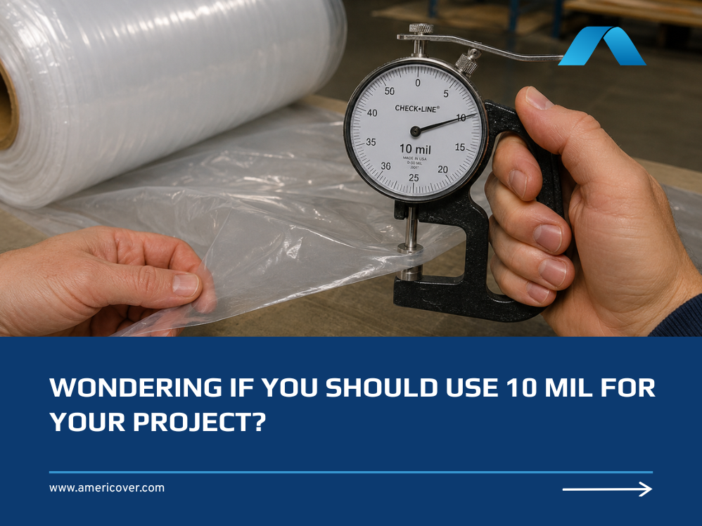
A “mil” is one-thousandth of an inch. So 10 mil plastic sheeting is 0.010 inches thick — roughly the thickness of two sheets of standard copy paper stacked together.
That’s thick enough to:
- Resist punctures from common jobsite debris
- Stand up to foot traffic and equipment movement
- Hold a seal under tape and adhesives without tearing
- Provide a strong moisture and vapor barrier when properly installed
It’s not thick enough to:
- Function as a long-term geomembrane or pond liner
- Reliably meet ASTM E1745 Class A vapor retarder performance (≤0.1 perms, plus tensile and puncture requirements) without specific testing certification
- Handle sustained heavy equipment traffic without underlayment
10 mil is the middle ground — heavier than throwaway poly, lighter than industrial liner. That’s exactly why it shows up on so many jobs.
How 10 Mil Compares to Other Common Thicknesses
| Thickness | Typical Use | Durability | Best For |
|---|---|---|---|
| 4 mil | Light-duty covering | Low | Painter’s drop cloth, dust cover |
| 6 mil | General construction | Moderate | Temporary vapor barriers, short-term covers |
| 10 mil | Heavy-duty construction and containment | High | Crawl spaces, containment walls, surface protection |
| 15 mil | Typically used for Class A vapor barriers | Very high | Permanent under-slab vapor retarders meeting ASTM E1745 performance criteria |
| 20 mil+ | Industrial liner | Maximum | Encapsulated crawl spaces, heavy-duty containment |
Best Use Cases for 10 Mil Plastic Sheeting
1. Construction Containment
When you need to isolate a work area — for dust, debris, demolition, or active trades — 10 mil poly for containment is the standard call. It holds up to tape, zipper doors, and negative air pressure without tearing at the seams. On remediation jobs where debris can puncture thinner plastic, the extra thickness pays for itself in fewer patch repairs.
Common containment scenarios:
- Demolition isolation walls
- Lead and asbestos abatement enclosures (when paired with flame-retardant variants)
- Hospital and data center construction zones requiring dust control
- Active jobsite separation between trades
2. Crawl Space Liners and Encapsulation
10 mil is a common choice for crawl space vapor barriers — particularly in moderate-moisture conditions or where the homeowner isn’t committing to full encapsulation. It’s heavier than the 6 mil that often comes standard in production homes, and it stands up to occasional foot traffic from HVAC or plumbing techs.
For fully encapsulated crawl spaces with regular service traffic, 15–20 mil reinforced products are the better long-term choice. But for retrofits, moisture remediation, and mid-tier installations, 10 mil delivers strong performance at a manageable cost.
3. Surface and Floor Protection
Heavy duty plastic sheeting at 10 mil is used to protect finished floors, countertops, and surfaces during construction. It holds up under tool drops, foot traffic, and dragged equipment far better than 4–6 mil films. String-reinforced versions add tear resistance for high-traffic zones.
4. Temporary Roofing and Weatherproofing
When a roof is opened up for repair or a structure is mid-build, 10 mil sheeting — especially reinforced variants — serves as a temporary weather barrier. It resists wind flap, UV exposure (for short durations), and water intrusion better than lighter films.
5. Equipment, Material, and Outdoor Covers
Stored lumber, machinery, HVAC units, and staged materials all need protection from rain, dust, and UV. 10 mil sheeting is durable enough to stay in place through wind and weather for weeks at a time without shredding. Reinforced versions extend that window further.
6. Vapor Barriers in Specific Applications
While 10 mil isn’t the standard for Class A under-slab vapor barriers (ASTM E1745 typically calls for 15 mil minimum for Class A performance), it’s commonly used for:
- Wall vapor barriers in moisture-prone construction
- Above-grade vapor retarders
- Temporary slab protection during cure
- Vapor barriers in light commercial and residential retrofits
What to Look For in a 10 Mil Product
Not all 10 mil sheeting is the same. When you’re matching a product to a job, check:
- Reinforcement — String-reinforced or scrim-reinforced 10 mil offers significantly better tear resistance than standard film
- Fire rating — For containment in occupied buildings, look for products meeting NFPA 701 or ASTM E84 flame-spread requirements
- UV stability — Outdoor and temporary roof applications need UV-stabilized film
- Sheet size — Larger sheets mean fewer seams, which means fewer failure points
- Manufacturer origin — USA-manufactured product ensures consistent quality control and BABA compliance for government projects
Frequently Asked Questions
Is 10 mil plastic sheeting thick enough for a crawl space vapor barrier?
For most residential crawl spaces and moisture remediation projects, yes. For full encapsulation with regular service traffic or high-moisture environments, 15–20 mil reinforced products perform better long-term.
What’s the difference between 10 mil and 6 mil plastic sheeting?
10 mil is roughly 67% thicker than 6 mil, with significantly higher puncture and tear resistance. 6 mil is suited for temporary or light-duty applications. 10 mil handles real construction and containment work.
Can 10 mil plastic sheeting be used outdoors?
Yes, especially UV-stabilized and reinforced variants. For long-term outdoor use, look for products specifically rated for UV exposure. Standard non-UV film will degrade in sunlight over weeks to months.
Does 10 mil meet ASTM E1745 Class A vapor barrier requirements?
ASTM E1745 Class A is defined by performance — primarily a permeance rating of 0.1 perms or less, plus tensile and puncture thresholds — not by mil thickness. Some 10 mil products may meet those requirements with proper testing and certification, but most Class A vapor barriers on the market are 15 mil or thicker because hitting the performance numbers consistently is easier at that range. Always check the spec sheet, not the thickness.
Is 10 mil plastic sheeting fire-rated?
Only specific flame-retardant (FR) variants are. Standard 10 mil poly is not fire-rated. For containment in occupied buildings, schools, hospitals, or commercial spaces, specify an FR product meeting NFPA 701 or ASTM E84 requirements.
Find the Right 10 Mil Sheeting for Your Project
Americover stocks a full range of 10 mil plastic sheeting — including string-reinforced, flame-retardant, and UV-stabilized variants — all USA-manufactured and ready to ship.
Shop 10 mil plastic sheeting →