How to match plastic sheeting to the job on a livestock operation, from barn curtains and calving-season windbreaks to feed covers and manure storage liners.
A north wind hits the calving pen at 2 a.m. Rain soaks a stack of straw bedding. A sick heifer needs to come out of the herd before the rest of the pen catches what she has. Every livestock operation hits these problems. Most of them can be solved with the right sheet of plastic.
The key word is right. A cover that holds up through one winter can be the wrong choice for a four-year hoop barn. A liner that works for a stock pond doesn’t qualify for a manure lagoon. This guide covers how livestock covers and liners work, which specs matter, and which material fits each job.
What Are Livestock Covers and Liners?
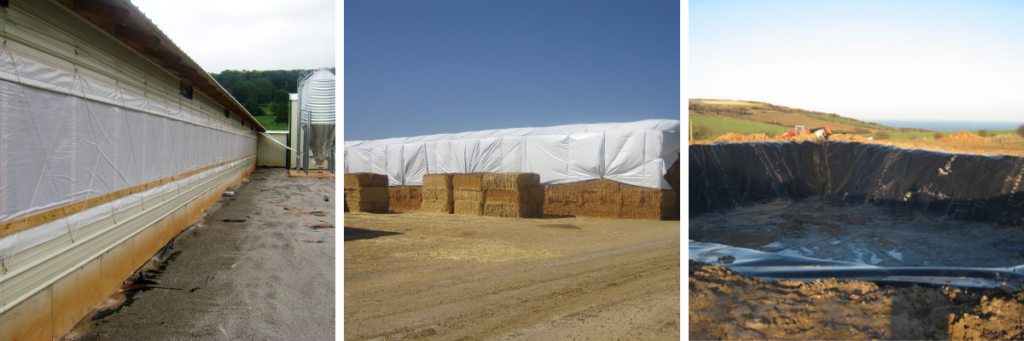
Covers keep weather out. Liners keep liquids in. On a farm or ranch, that breaks down into four common jobs:
- Barn curtains and windbreaks. Sidewall curtains, open-front shed covers, and temporary wind walls around pens.
- Shelter and hoop barn covers. Long-term covers over a frame, where you want daylight inside.
- Feed and bedding covers. Tarps over hay, straw, and commodity piles that keep out rain and snowmelt.
- Containment liners. Linings for stock ponds, wash water basins, and manure storage.
How It Works: Three Specs That Decide the Job
Thickness gets the attention. It’s rarely the deciding spec. Three other properties tell you whether a material will last.
UV resistance sets the lifespan outdoors. Sunlight breaks down polyethylene. Without UV inhibitors, even heavy reinforced sheeting turns brittle in the sun. Americover sells UV-resistant sheeting rated from 1 to 4 years. Pick the rating that matches how long the cover stays up.
Reinforcement sets tear resistance. Wind whips curtains. Cattle rub and push on them. A scrim grid or woven core stops a puncture from turning into a tear that runs the length of the sheet.
Seams decide whether a liner leaks. Every field seam is a possible leak point. Custom panels fabricated to size cut the number of seams your crew has to make on site.
Standards Worth Knowing
NRCS Conservation Practice Standard 521 covers geomembrane pond liners. If your manure storage project goes through NRCS cost-share, this is the standard it gets designed to. Beyond the thickness minimums, it requires cover soil within 24 hours of placing the liner, where the design calls for cover. Depending on your soil type, it can also require a leak detection system under a waste storage liner. (USDA NRCS) Your local NRCS office has the current version for your state.
Fire performance inside barns. Some insurers and local fire officials require fire-retardant sheeting for curtains inside enclosed animal housing. The requirements vary by state and county. Ask your insurer and local fire official before you buy. If they require it, Americover carries fire-retardant plastic sheeting that ships with fire certificates.
Specifications: Matching Material to Job
| Product | Image | Key Spec | Link |
|---|---|---|---|
| 6 mil Clear Dura-Skrim® Reinforced Plastic Sheeting |  |
|
View product → |
| SolaScrim™ 4 Year 10 mil Clear Reinforced Cover |  |
|
View product → |
| Custom Fabricated Woven Coated Poly |  |
|
View product → |
| Custom Fabricated HDPE Geomembrane Liner |  |
|
View product → |
Practical Applications
Quarantine pens and calving-season windbreaks
Do you need to isolate a sick animal this week or block wind for a few months of calving? 6 mil Dura-Skrim goes up fast and resists tearing far better than plain 6 mil poly. It has no UV inhibitors, though. Use it indoors or take it down after the season.
Hoop barns and long-term shelter covers
If the cover stays up year-round and you want daylight inside, go with SolaScrim 10 mil. Its UV package is built for up to 4 years outdoors. The polyester scrim handles wind load on a frame.
Heavy curtains and feed and bedding covers
For sidewall curtains that take abuse from animals, or covers over hay and straw, woven coated poly is the workhorse. Choose white to reflect heat or black to block light. Americover can fabricate it with reinforced edges and grommets, so it’s ready to hang.
Ponds, wash water, and manure storage
Use HDPE geomembrane for long-term containment. Size the thickness for the contents. Clear-water stock ponds start at 30 mil under NRCS 521. Manure and wastewater storage starts at 60 mil. HDPE works above ground too. Elk ranchers have hung 30–40 mil HDPE on fencing to keep antlers out of the wire, as covered in this earlier post.
Frequently Asked Questions
What is the best plastic for barn curtains?
It depends on exposure. Use UV-stabilized reinforced sheeting or woven coated poly for curtains that face sun and wind year-round. Check with your insurer about fire-retardant requirements for curtains inside enclosed housing.
How thick should a manure pond liner be?
The USDA NRCS Code 521 standard calls for at least 60 mil HDPE for wastewater storage, versus 30 mil for clear water. Confirm the current version with your local NRCS office, especially if the project is cost-shared.
Can I use woven poly to line a manure lagoon?
No. NRCS Code 521 lists reinforced slit-film woven polyethylene as not recommended for waste storage. Woven coated poly is a good fit for covers and clear-water applications.
How long will a plastic cover last on a livestock shelter?
UV resistance decides it. Sheeting without UV inhibitors is for short-term outdoor use. UV-stabilized covers like SolaScrim are built for up to 4 years outdoors, depending on installation and exposure.
Are Americover livestock covers and liners made in the USA?
Yes. All four products covered here are American-made.
Get the Right Cover on the Right Job
Tell us what you’re covering or containing and how long it needs to last. We’ll help you choose the material and fabricate it to size. Shop livestock curtains and barriers →