
If you’re specifying materials for a metal roof — residential, commercial, industrial, or a historical restoration — the panels get the attention. The layers underneath do the actual work of keeping the structure dry, quiet, and free of corrosion.
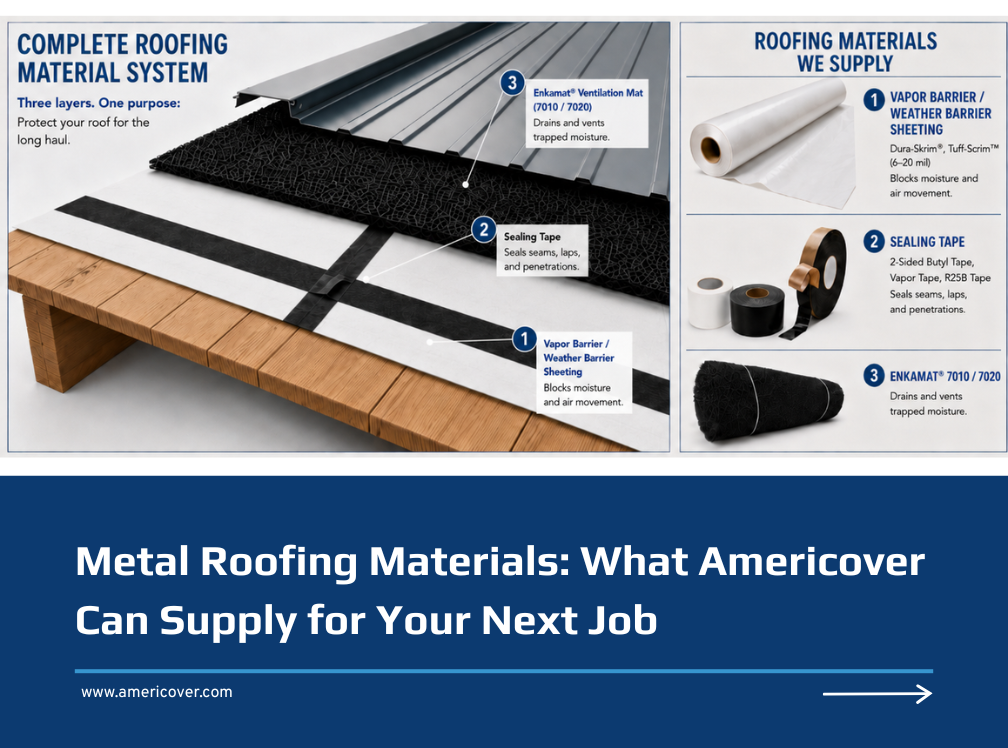
Americover supplies three categories of product that make up a complete roofing material system: vapor barrier sheeting, sealing tape, and Enkamat® ventilation mat. Here’s what each one does and where it fits.
Key Principle: A roofing vapor barrier only performs as well as its seams. Sheeting, tape, and ventilation are a system — skip one layer and the other two have to work harder, or fail. For a deeper look at vapor retarder performance, see our Roof Vapor Retarders & Air Barriers guide.
What’s Actually in a Roofing Material System?
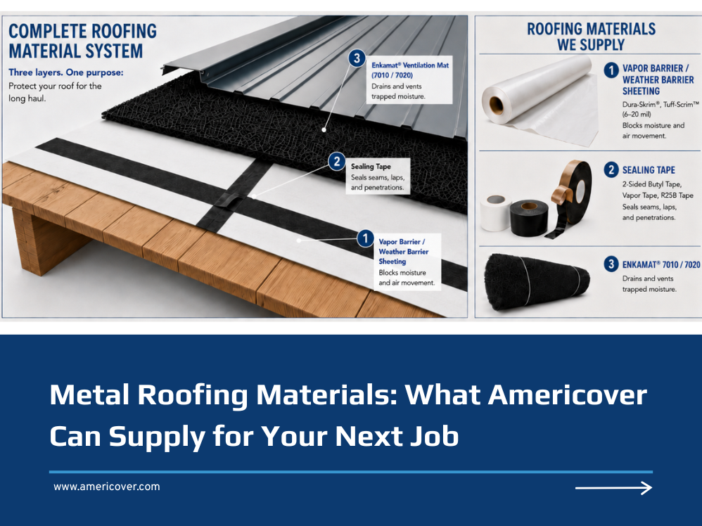
Three layers, each solving a different problem:
- Vapor barrier / weather barrier sheeting — blocks moisture and air from moving into the roof assembly.
- Sealing tape — keeps seams, laps, and penetrations continuous so the barrier doesn’t have weak points.
- Enkamat ventilation mat — creates an airspace under the metal panel so any moisture that does form can drain and evaporate instead of sitting against the metal.
| Layer | Americover Products | Function |
| Vapor/weather barrier | Dura-Skrim®, Tuff-Scrim™ (6–20 mil) | Blocks moisture and air movement |
| Sealing tape | 2-Sided Butyl Tape, Vapor Tape, R25B Tape | Seals seams, laps, and penetrations |
| Ventilation mat | Enkamat® 7010 / 7020 | Drains and vents trapped moisture |
How Each Layer Works
Vapor Barrier / Weather Barrier Sheeting
Americover stocks Dura-Skrim® and Tuff-Scrim™ reinforced poly sheeting in thicknesses from 6 to 20 mil under its Roofing Vapor Barriers line. Thicker isn’t automatically better — it’s a tradeoff between puncture resistance and cost. A 6 mil sheet handles routine exposure; 12 to 20 mil options are built for jobs with heavier foot traffic during installation or harsher climate exposure. If code requires a fire-rated barrier, Dura-Skrim Fire Retardant sheeting meets NFPA 701 and ASTM E-84 Class A flame spread requirements and is printed “FIRE RETARDANT” directly on the film for easy inspection.
Sealing Tape for Seams and Penetrations
Even a good vapor barrier fails at an unsealed seam. Americover’s 2-Sided Butyl Tape is reinforced with a cloth carrier and tests at 256 oz/in adhesion to polyethylene (ASTM D903) — it’s the tape to use at piers, wall transitions, and rough or textured surfaces. Vapor Tape uses a pressure-sensitive rubber adhesive that allows repositioning before it sets, and it’s the better choice for panel-to-panel seams up to 20 mil thick. R25B Tape is a single-sided, UV-stable option for high-stress seams that need an aggressive instant bond.
Enkamat® Ventilation and Drainage Mat
Enkamat is a three-dimensional nylon mat that installs beneath metal panels, zinc, copper, or ballast material. It creates an open channel that lets incidental moisture drain and evaporate instead of collecting against the underside of the panel — which is what drives white rust on zinc roofs and mildew on any metal surface. Americover carries Enkamat 7010 and 7020; 7020 is the thicker option when a job calls for more airspace and drainage capacity. It’s a standard spec on historical restoration work because it’s a reversible, non-adhered layer that protects the roof without altering the original assembly.
Key Insight: Vapor barrier and tape control moisture at the seams. Enkamat controls moisture that gets past the seams anyway. On zinc, copper, and restoration work, specifying only one or two of the three layers leaves a known failure point uncovered.
Standards and Specs Worth Asking For
- Permeance: Roofing vapor retarders should carry a perm rating of 1.0 or less.
- Adhesion: Butyl tape adhesion to polyethylene is tested under ASTM D903 — ask for the number, not just the product name.
- Fire rating: Where code requires it, confirm the sheeting meets NFPA 701 and ASTM E-84 Class A.
- Domestic sourcing: BABA-compliant options are available for federally funded projects — confirm requirements with your account manager before ordering.
Where These Materials Show Up on the Job
Residential and commercial standing seam metal roofs use the full system — vapor barrier, sealed seams, Enkamat — for moisture control and noise reduction under the panel. Industrial and post-frame buildings with metal roofs lean on the vapor barrier and tape to control condensation from warm, moist interior air meeting a cold metal roof. Zinc and copper roofing, including historical restoration, specify Enkamat specifically to prevent condensation-driven corrosion. Where code requires it, fire-retardant sheeting adds a compliance layer without changing the rest of the system.
FAQ
- What’s the difference between a roofing vapor barrier and a ventilation mat? A vapor barrier is reinforced poly sheeting that blocks moisture and air from entering the roof assembly. A ventilation mat like Enkamat sits under the metal panel and creates an open channel so moisture that does form can drain and evaporate instead of getting trapped.
- Do I need Enkamat under every metal roof? Not every job needs it, but it’s standard on zinc, copper, ballasted, and historical restoration roofing where condensation-driven corrosion is a real risk. Standard steel panel roofs with adequate ventilation may only need the vapor barrier and sealed seams.
- What tape should I use to seal roofing vapor barrier seams? Use 2-sided butyl tape at piers, walls, and rough transitions, and vapor tape for panel-to-panel seams. R25B tape is an option for high-stress seams needing an aggressive single-sided bond.
- What mil thickness is right for a roofing vapor barrier? Roofing vapor barriers commonly run 6 to 20 mil. Thicker options add puncture resistance for jobs with heavy foot traffic or harsh climate exposure. Regardless of thickness, look for a permeance rating of 1.0 perms or less.
- Is fire-retardant sheeting available for roofing applications? Yes. Dura-Skrim Fire Retardant reinforced sheeting meets NFPA 701 and ASTM E-84 Class A flame spread requirements, suitable for commercial and industrial jobs where code requires a fire-rated barrier.
- Can these materials be used on historical restoration projects? Yes. Enkamat is commonly specified on zinc and copper restoration work because it’s a reversible, non-adhered ventilation layer that protects the metal without altering the original roof assembly.
Get the Right Materials on the Truck Before the Panels Show Up
Every layer above ships from stock, and every customer gets a dedicated account manager to match the right thickness, tape, and mat to your job. Shop the full roofing vapor barrier lineup →
Call 760-388-6294 to talk through your project.