
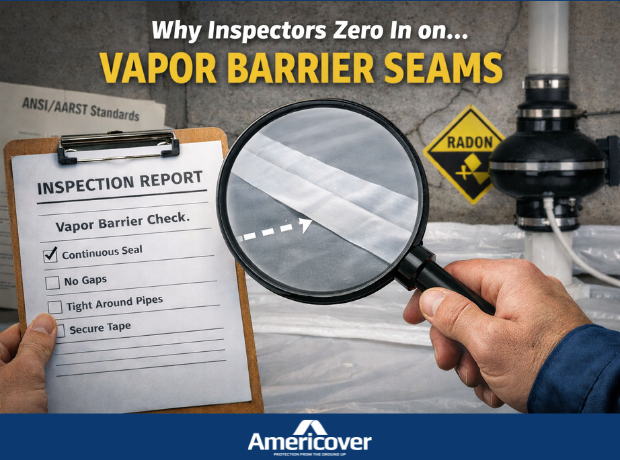
What radon mitigation contractors need to know about ASTM E1745, ANSI/AARST seam-sealing requirements, and choosing tape that holds under suction — not just moisture pressure.
When a radon mitigation system fails inspection, it’s rarely the fan or the piping. More often, it comes down to one thing: improperly sealed vapor barrier seams.
For radon mitigation contractors, seam sealing gets more scrutiny than almost any other part of the install. A well-designed system can still fail inspection — or underperform for years afterward — if seams and penetrations aren’t sealed to hold under suction, not just resist moisture.
What Is Radon Vapor Barrier Seam Sealing?
Radon vapor barrier seam sealing is the process of joining overlapping sheets of soil gas retarder membrane — plus every penetration, pipe boot, and wall termination — into one continuous, airtight surface. It’s not the same job as sealing a standard moisture vapor barrier.
A crawl space or under-slab barrier installed purely for moisture control only has to slow vapor diffusion. A radon barrier under an active soil depressurization system has to do that and hold against continuous mechanical suction. That distinction is why seams that pass a moisture inspection can still fail a radon inspection.
How It Works
Radon mitigation relies on controlling soil gas movement, not just blocking it passively. In an active system, a fan draws air from beneath the membrane and vents it outside, creating a negative pressure field under the barrier. Any unsealed seam or penetration becomes a bypass point — instead of pulling soil gas, the system starts pulling conditioned air from the crawl space or basement, which collapses the pressure field the whole system depends on.
That’s why inspectors focus on:
- Continuous vapor barrier coverage with no visible gaps at seams or edges
- Tight, fully bonded seals around every pipe, suction pit, and penetration
- Tape that stays adhered — no lifting, curling, or delamination
- Reinforcement in high-traffic areas where the membrane sees foot traffic or service work
Standards That Govern Seam Sealing
Two sets of standards define what “sealed” means for radon work:
- ASTM E1745 — Sets performance classes for plastic vapor retarders used against soil or under slabs. Class A is the highest tier: maximum 0.1 perms, minimum 45 lb/in tensile strength, and minimum 2,200 grams puncture resistance. (ASTM)
- ANSI/AARST CC-1000 and SGM-SF — The soil gas control and mitigation standards from the American Association of Radon Scientists and Technologists require that the soil gas retarder, including its seams and edges, be sealed to resist air movement between the soil and the space above the membrane — not just resist moisture. (AARST)
The U.S. Environmental Protection Agency references AARST’s ANSI-approved standards directly as the current standards of practice for radon mitigation. (EPA)
Specifications: Choosing the Right Tape for the Job
| Product | Image | Key Spec | Link |
|---|---|---|---|
| Vapor Barrier Tape | 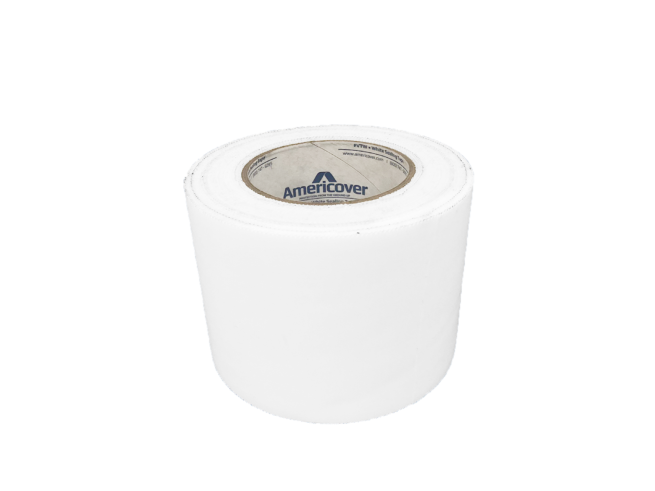 |
4″ x 180′, 7 mil, ASTM D3833 | View product → |
| 2-Sided Butyl Tape | 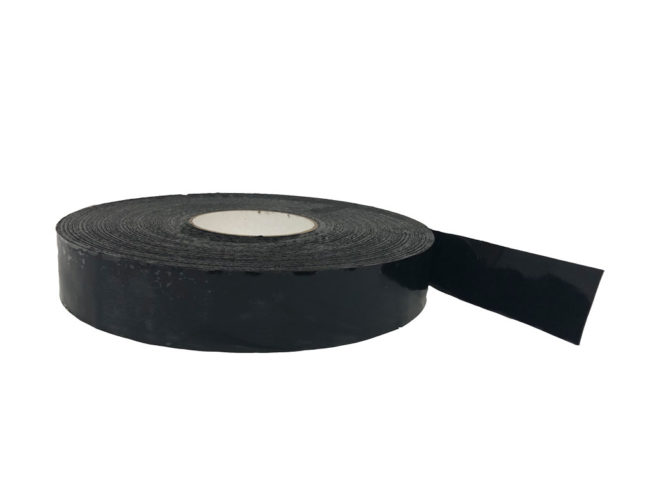 |
1.5″ x 108′, 256 oz/in adhesion to PE (ASTM D903) | View product → |
| R25B Tape |  |
4″ x 100′, 8 mil, permeance under 0.005 g/(24h·100in²) | View product → |
Practical Applications
Different areas of a radon install call for different sealing solutions:
- Vapor Barrier Tape for clean, flat overlaps between full sheets of membrane — the majority of seam length on most jobs.
- 2-Sided Butyl Tape for wall terminations, piers, and rough or dusty concrete, where the tape needs to bond aggressively to more than just polyethylene.
- R25B Tape for penetrations, patches, and any seam left exposed to UV or weather before the space closes in — it bonds instantly without heat welding, which matters on a field repair.
Common mistakes that show up during inspection:
- Using general-purpose tape not rated for vapor barrier or radon service
- Taping over dusty, damp, or unprepared concrete
- Overlaps under 6 inches that don’t hold once the fan pulls suction
- Rushing seam work at the end of the job instead of building it in as a step
For a real-world example of thickness and sealing working together on a high-risk site, see: Case Study: Solving Radon Problems with 20 Mil Vapor Block Plus, where a 20-mil VaporBlock® Plus barrier — whose multi-layer construction includes EVOH resin for added gas resistance — handled a severe radon site.
Frequently Asked Questions
Why does seam sealing cause more radon inspection failures than the fan or piping?
The fan and piping are usually installed to spec, while seams and penetrations are field work that varies with crew, weather, and surface conditions. A single unsealed seam can break the negative pressure field the whole system depends on, even when every other component passes.
What’s the difference between sealing a moisture vapor barrier and a radon vapor barrier?
A moisture-only barrier just needs to slow vapor diffusion. A radon barrier under an active system also has to hold its seal against continuous suction from the radon fan — a more demanding mechanical load on the tape and the bond.
Is duct tape or general-purpose tape acceptable for radon seam sealing?
No. Standard duct tape and general-purpose poly tape aren’t rated for the moisture and pressure conditions of a radon barrier, and they’re a common reason installations fail inspection or need rework.
What overlap is required at radon vapor barrier seams?
Overlaps of at least 6 inches, sealed with a compatible tape, are standard practice for radon and soil gas barriers. Always confirm the exact requirement with the project’s ANSI/AARST-certified professional and local jurisdiction.
Does ASTM E1745 apply to seam sealing, or just the barrier material?
ASTM E1745 sets performance classes for the membrane itself — permeance, tensile strength, and puncture resistance. Seam and edge sealing requirements come from ANSI/AARST soil gas mitigation standards, which specify that the retarder’s seams and edges must be sealed to resist air movement.
How do I know which tape to use where on a radon install?
Match the tape to the surface and exposure: flat overlaps between full sheets typically use a vapor barrier tape, rough or dusty concrete and wall terminations call for an aggressive butyl tape, and exposed or UV-prone seams benefit from a tape rated for outdoor and instant-bond application.
Get the Tape Built for Radon-Grade Seams
Americover supplies the seam sealing tapes and radon-resistant vapor barriers contractors need to pass inspection the first time — backed by 30+ years of American manufacturing. Browse radon mitigation vapor barrier solutions →